


Exponential time–differencing (ETD) and integrating factor (IF) Runge–Kutta solvers for stiff semi-linear PDEs:
$u_t = L u + \mathrm{NL}(u)$
- Fast, adaptive, and pure Python (NumPy/SciPy only)
- Embedded error control, logging, and flexible operator support
- Designed for spectral methods and diagonalizable systems
Tested: Python 3.9–3.13 | Dependencies: NumPy, SciPy | Optional: matplotlib, jupyter, pytest
Docs: rkstiff.readthedocs.io
- Adaptive ETD/IF Runge–Kutta solvers: ETD35, ETD34, IF34, IF45DP (embedded error control)
- Fixed-step solvers: ETD4, ETD5, IF4
- Operator flexibility: Diagonal or full matrix (spectral/finite-difference)
- Spectral methods: Fourier/Chebyshev support
- Configurable error control:
SolverConfigfor tolerances, safety factors - Logging: Per-solver logging, adjustable verbosity
- Lightweight API: Pass a linear operator array and a callable nonlinear function
- Utility modules: Grids, spectral derivatives, transforms, models, logging helpers
Supported equations: Nonlinear Schrödinger, Kuramoto–Sivashinsky, Korteweg–de Vries, Burgers, Allen–Cahn, Sine–Gordon
pip (recommended):
python -m pip install rkstiffconda-forge:
conda create -n rkstiff-env -c conda-forge rkstiff
conda activate rkstiff-env
From source:
git clone https://github.com/whalenpt/rkstiff.git
cd rkstiff
python -m pip install .
Extras:
# demos: matplotlib + jupyter; tests: pytest
python -m pip install "rkstiff[demo]"
python -m pip install "rkstiff[test]"import numpy as np
from rkstiff import grids, if34
# Real-valued grid for rfft
n = 1024
a, b = 0.0, 32.0 * np.pi
x, kx = grids.construct_x_kx_rfft(n, a, b)
# Linear operator in Fourier space
lin_op = kx**2 * (1 - kx**2)
# Nonlinear term: -F{ u * u_x }
def nl_func(u_fft):
u = np.fft.irfft(u_fft)
ux = np.fft.irfft(1j * kx * u_fft)
return -np.fft.rfft(u * ux)
# Initial condition in real space → Fourier space
u0 = np.cos(x / 16) * (1.0 + np.sin(x / 16))
u0_fft = np.fft.rfft(u0)
solver = if34.IF34(lin_op=lin_op, nl_func=nl_func)
uf_fft = solver.evolve(u0_fft, t0=0.0, tf=50.0, store_freq=20)
# Convert stored Fourier snapshots back to real space
U = np.array([np.fft.irfft(s) for s in solver.u]) # shape: (num_snaps, n)
t = np.array(solver.t)
solver.uandsolver.tstore snapshots everystore_freqinternal steps;evolvereturns the final state.
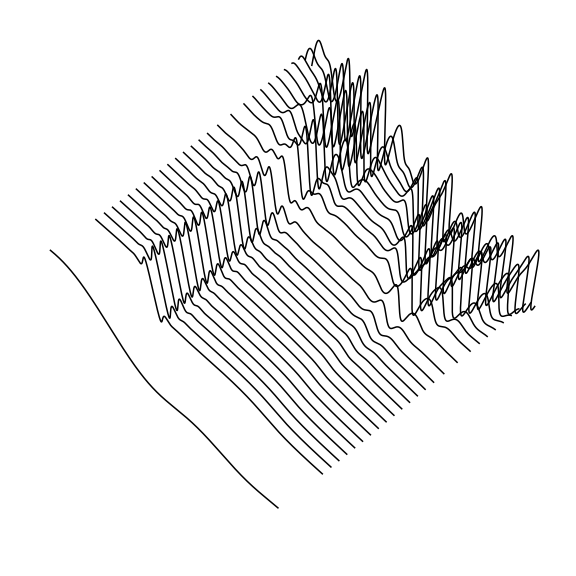
Kuramoto–Sivashinsky chaotic field propagation using IF34.
💡 More examples:
Several fully runnable Jupyter notebooks are included in thedemos/folder.
Each notebook illustrates solver usage, adaptive-step control, and visualization for different PDEs
(e.g., Kuramoto–Sivashinsky, NLS, and Allen–Cahn).
To try them:python -m pip install "rkstiff[demo]" jupyter notebook demos/
| Solver | Module | Order (embedded) | Adaptive | Notes |
|---|---|---|---|---|
ETD35 |
etd35 |
5 (3) | ✅ | Best for diagonalized systems |
ETD34 |
etd34 |
4 (3) | ✅ | Krogstad 4th order |
IF34 |
if34 |
4 (3) | ✅ | Integrating factor |
IF45DP |
if45dp |
5 (4) | ✅ | Dormand–Prince IF |
ETD4 |
etd4 |
4 (–) | ❌ | Krogstad fixed-step |
ETD5 |
etd5 |
5 (–) | ❌ | Same base as ETD35 |
IF4 |
if4 |
4 (–) | ❌ | Fixed-step IF |
Solver(lin_op: np.ndarray, nl_func: Callable[[np.ndarray], np.ndarray], config: SolverConfig = ..., loglevel: str = ...)lin_op: array shaped likeu, typically diagonal entries in the working basisnl_func(u): returns nonlinear term in same basisconfig: error control and adaptivity (optional; defaults to SolverConfig())loglevel: logging verbosity (optional; defaults to "INFO")
Configure embedded error estimation and adaptive step control via SolverConfig:
from rkstiff.if34 import IF34
from rkstiff.solveras import SolverConfig

config = SolverConfig(epsilon=1e-5, incr_f=1.2, decr_f=0.8, safety_f=0.9)
solver = IF34(lin_op, nl_func, config=config, loglevel="INFO")
Parameter notes (typical meanings):
epsilon: target local error tolerance for the embedded pair.safety_f: safety factor applied to proposed step-size updates.incr_f/decr_f: bounds on how muchdtmay grow/shrink on accept/reject.- (Implementation-specific fields may exist; see docs for full list and defaults.)
Set logging level per solver:
solver = IF34(lin_op, nl_func, loglevel="DEBUG")grids: Grid and wavenumber construction for FFT/RFFT/Chebyshevderivatives: Spectral differentiation (FFT, RFFT, Chebyshev)transforms: Basis transformsmodels: Example PDEsutil.loghelper: Logging setup and control
- For spectral methods, pass
lin_opin Fourier space and implementnl_funcin that same space - For diagonalizable systems, pre-diagonalize once and reuse that basis
- ETD methods may precompute φ-functions; reuse the solver instance for speed
- Storage:
solver.uandsolver.thold snapshots; control frequency withstore_freq
Run tests and view coverage:
python -m pip install "rkstiff[test]"
pytestIf you use rkstiff in academic work, please cite:
P. Whalen, M. Brio, J.V. Moloney, Exponential time-differencing with embedded Runge–Kutta adaptive step control, Journal of Computational Physics 280 (2015) 579–601. DOI: 10.1016/j.jcp.2014.09.038
@article{WhalenBrioMoloney2015,
  title   = {Exponential time-differencing with embedded Runge--Kutta adaptive step control},
  author  = {Whalen, P. and Brio, M. and Moloney, J. V.},
  journal = {Journal of Computational Physics},
  volume  = {280},
  pages   = {579--601},
  year    = {2015},
  doi     = {10.1016/j.jcp.2014.09.038}
}MIT — see LICENSE for details.
Patrick Whalen — [email protected]