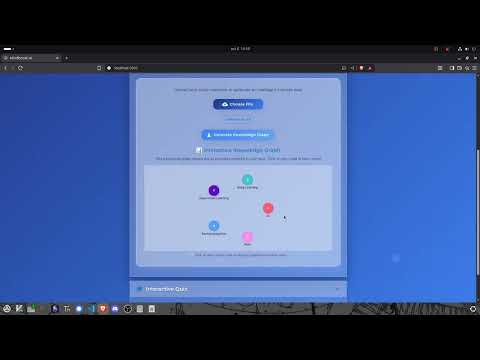
MindBoost is an intelligent academic companion platform built with a microservices architecture.
It helps students and educators analyze study materials, generate knowledge graphs, create quizzes, track learning progress, and monitor academic well-being.
The system integrates AI-powered document parsing, knowledge extraction, quiz generation, burnout prediction, and interest tracking, all accessible via a modern React frontend orchestrated with Docker Compose.
- Overview
- Architecture
- Microservices Included
- Technologies Used
- ML Model: Burnout Predictor
- Running the System
- Running Microservices Individually
- Test Users
- Initial Setup
- Versioning & Contribution
MindBoost combines data processing, AI inference, and interactive dashboards to assist academic users in managing knowledge and maintaining a healthy balance between learning and well-being.
Core functionalities include:
- Parsing and analyzing uploaded study materials.
- Generating knowledge graphs to visualize concepts.
- Creating and scoring AI-generated quizzes.
- Monitoring user interest and burnout risk through machine learning.
- Providing real-time analytics via Streamlit dashboards.
All services are containerized and orchestrated via Docker Compose.
Below is a simplified system diagram illustrating the service interactions:
graph TD
A[Frontend] --> B[Backend API Gateway]

C[PDF Parser Microservice] --> E[Bedrock Client Microservice]
C --> D
B --> D[Knowledge Graph Microservice]
B --> E
D --> J
B --> F[Quiz Burnout Gateway]
F --> G[Quiz Score Microservice]
G --> L[(MongoDB)]
G --> K[Interest Monitor Streamlit]
K --> O[(MongoDB)]
F --> H[ML Model Burnout]
H --> I[Trained Model]
E --> J[Bedrock Monitor Streamlit]
flowchart TD
    subgraph User Interaction
        A[Login ]
        C[PDF Upload]
        M[Burnout Detection Button]
    end

    subgraph Processing
        D[PDF Parser Microservice]
        E[Extracted Text]
        F[Knowledge Graph Microservice]
        H[Bedrock Client Microservice]
        O[ML Model Burnout Microservice]
        Q[Bedrock Monitor Microservice]
    end

    subgraph Storage
        K[(MongoDB)]
    end

    subgraph Output
        G[Knowledge Graph Visualization]
        I[Quiz Generation]
        J[Quiz Score Microservice]
        L[User Takes Quiz]
        P[Burnout Risk Result]
        R[Usage & Cost Analytics]
    end

    A --> B[Backend]
    A --> C
    C --> D
    D --> E
    E --> F
    F --> G
    E --> H
    H --> I
    I --> J
    J --> K
    I --> L
    L --> J
    M --> N[Quiz Burnout Gateway]
    N --> K
    N --> O
    O --> P
    H --> Q
    Q --> R
| Service | Technology | Description | Port |
|---|---|---|---|
| backend | FastAPI | Main API Gateway, routes all requests | 8000 |
| pdf-parser-microservice | FastAPI | Parses PDF files and extracts text | 8001 |
| bedrock-client-microservice | FastAPI + Boto3 | Connects to AWS Bedrock for LLM tasks | 8002 |
| knowledge-graph-microservice | FastAPI + NetworkX | Generates knowledge graphs from parsed text | 8003 |
| ml-model-burnout | Flask | Predicts burnout probability using ML model | 8004 |
| quiz-score-microservice | Flask | Computes quiz results and stores them in MongoDB | 8010 |
| quiz-burnout-gateway | Flask | Aggregates quiz data and calls burnout model | 8011 |
| interest-monitor-microservice | Flask + Streamlit | Displays user topic interests and analytics | 8502 |
| mongodb | MongoDB | Stores quiz results, user data, and interests | 27017 |
| bedrock-monitor | Streamlit | Dashboard for Bedrock Client metrics | 8501 |
| frontend | React + MUI | Web interface for interacting with MindBoost | 3000 |
The ml-model-burnout microservice predicts a user’s likelihood of academic burnout using a trained model.
- Model:
model.pkl(pre-trained using joblib) - Input: Time series of scores (e.g., stress, wellbeing)
- Output: Probability of being close to burnout (0–1)
{
  "user_id": "u1",
  "series": [
    {"date": "2025-01-05", "score": 82},
    {"date": "2025-01-12", "score": 78},
    {"date": "2025-01-20", "score": 74}
  ]
}{
"user_id": "u1",
"prob_close_to_burnout": 0.78,
"features": { ... }
}You can run the entire MindBoost platform using Docker Compose.
# Build and start all services
docker-compose up --build
After all services start:
- Frontend: http://localhost:3000
- Bedrock Monitor: http://localhost:8501
- Interest Monitor: http://localhost:8502
- API Gateway: Accessible at
http://localhost:8000
Each service can be started separately for local development:
| Service | Directory | Command |
|---|---|---|
| Backend (Gateway) | src/backend |
uvicorn src.main:app --reload |
| PDF Parser | src/pdf-parser-microservice |
uvicorn src.main:app --reload |
| Bedrock Client | src/bedrock-client-microservice |
uvicorn src.main:app --reload |
| Knowledge Graph | src/knowledge-graph-microservice |
uvicorn src.main:app --reload |
| ML Model Burnout | src/ml_model_burnout |
flask --app predict_service run --host=0.0.0.0 --port=8004 |
| Quiz Score | quiz-score-microservice |
flask --app main run --host=0.0.0.0 --port=8010 |
| Quiz Burnout Gateway | quiz-burnout-gateway |
flask --app main run --host=0.0.0.0 --port=8011 |
| Bedrock Monitor | bedrock-monitor |
streamlit run app.py |
| Interest Monitor | interest-monitor-microservice |
streamlit run app.py |
Use these credentials during development and testing:
| Password | |
|---|---|
| [email protected] | password123 |
| [email protected] | letmein456 |
| [email protected] | qwerty789 |
Before logging in for the first time, populate the local SQLite and MongoDB databases.
# Install dependencies
pip install -r misc/requirements.txt

# Run the database initialization script
python misc/init_db.py- Python: 3.9 / 3.10
- Node: 18+
- Dependencies managed via
requirements.txtandpackage.json.
Pull requests are welcome!
Please open an issue to discuss proposed changes before submitting.
MindBoost provides:
- Modular AI-powered learning analysis
- Seamless REST-based microservice communication
- Real-time dashboards for insightful monitoring
- A robust and scalable Dockerized environment